 Ελληνικά
 English
 Español
Trademark Registration Statistics (2022-2024)
09-12-2025
Summary for those who do not want to read the entire study
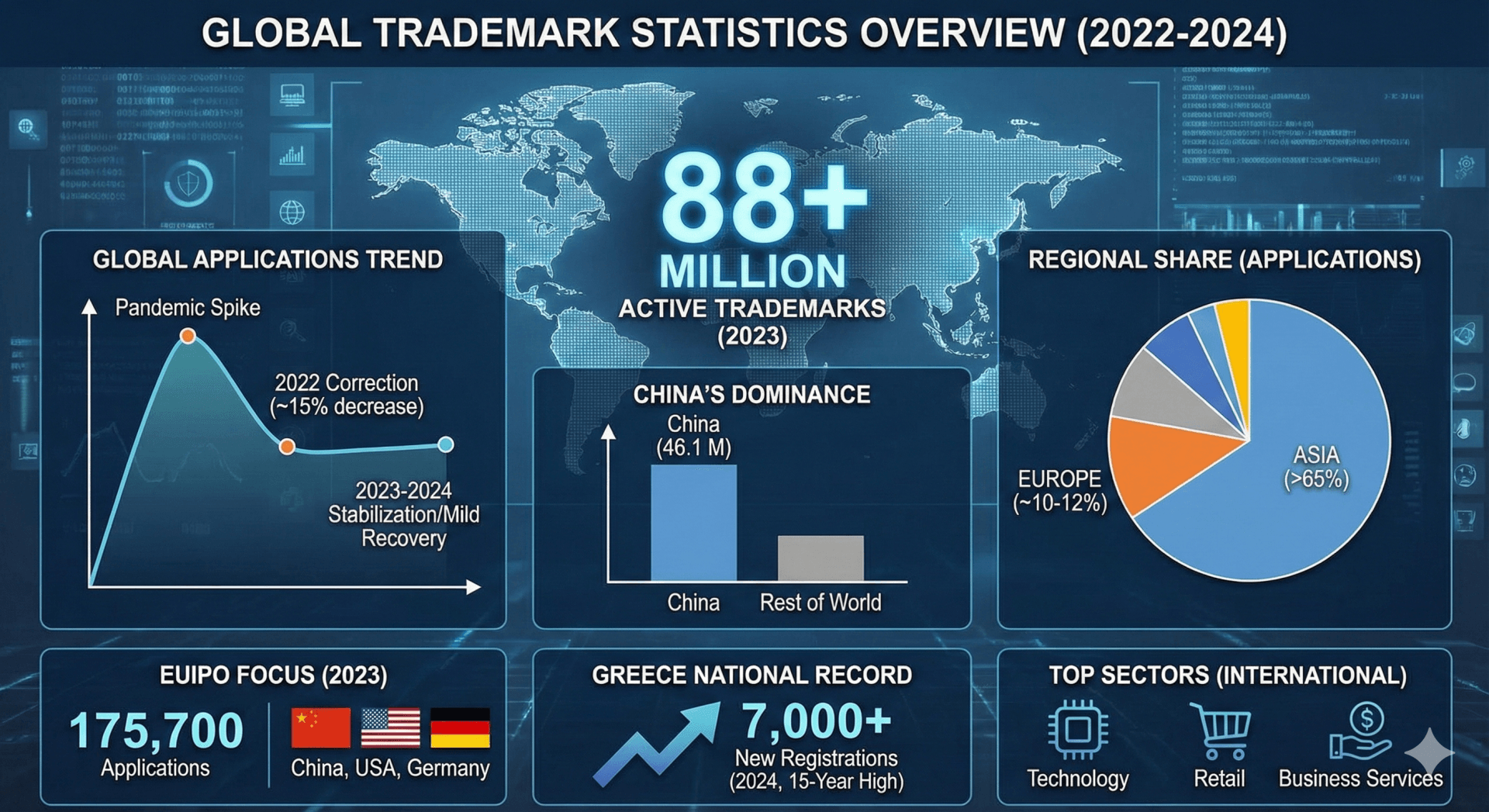
- Over 88 million active trademarks were recorded worldwide in 2023, with China maintaining a commanding lead by far (46.1 million).
- The year 2022 was one of correction following the pandemic "boom," with a decline of ~15% in global applications. 2023-2024 shows the stabilization of a mild recovery.
- Asia now dominates the global volume of applications (>65%), while Europe is receding (~10-12%) but remains a critical player.
- EUIPO gathered 175,700 applications in 2023, with China, the USA and Germany being the main countries of origin.
- Greece recorded a 15-year high in national applications in 2024, with 7,000+ new registrations.
- The most popular trademark sectors internationally are: technology, retail and business services.
Within this landscape, Greece is showing signs of increased business alertness and registration maturity. Synapsee is here to translate statistics into strategies - with full documentation, commercial insight and cutting-edge artificial intelligence.
Key Conclusions
- Active trademarks exceed 88 million worldwide (2023), with China holding 46.1 million.
- In 2022 there was a decline of ~15% in applications compared to 2021. 2023-2024 show signs of stabilization.
- Europe accounts for ~10-12% of applications, with EUIPO recording 175,700 applications in 2023.
- In Greece, applications reached 7,000 in 2024, a 15-year high.
- The most frequent trademark categories are: technology (Class 9), retail (35), R&D and design services (42).
- International registration (Madrid System) recorded 65,000 applications in 2024, with the USA, Germany and China at the top.
Detailed Study
International, regional & national applications (WIPO, EUIPO, national offices)
International Madrid System (WIPO): International applications through the Madrid System experienced a downturn in 2022-2023 but recovered in 2024. Specifically, in 2023 approximately 64,200 international applications were filed (-7% compared to 2022), while in 2024 they rose to 65,000 (+1.2%). The USA was the largest country of origin (~11,000 applications), followed by Germany, China, France and the United Kingdom.
European Union Trademark (EUIPO): EUIPO received 175,709 applications for an EU trademark (EUTM) in 2023. Of these, approximately 17% (29,462) came through international extensions (Madrid). The rest were filed directly. China, Germany and the USA were the main countries of origin.
National offices - The example of Greece: In Greece, applications to the OBI increased from 6,449 in 2023 to approximately 7,000 in 2024 - a 15-year high. National registration remains particularly important for SMEs due to its simplicity and low cost. Similar increases were observed in Italy and Spain. By contrast, the United Kingdom and other markets (Turkey, Iran) recorded a sharp decline.
Global aggregate figures
In 2022 there was a sharp decline in new trademark applications (approximately -15% compared to 2021), ending a 12-year run of growth. Approximately 15.5 million applications were filed (in terms of classes). In 2023 applications stabilized (~15.2 million classes) - just 1.3% fewer than in 2022. In 2024 a recovery trend is recorded, with a slight increase in international applications through WIPO (+1.2%).
The total number of active trademarks worldwide continued to grow: in 2023 there were 88.2 million registered trademarks, with China holding 46.1 million, while India and the USA each had approximately 3.2 million active.
Distribution by country - Leading markets
- China: 7.2 million applications in 2023, nearly 10 times more than the USA. A dominant presence in the global volume of filings.
- USA: 739,000 application classes in 2023. Declines in filings after the pandemic, but it remains the leading country of origin for international applications.
- India: 520,000+ applications (2023), on an upward trajectory and 4th place worldwide.
- European Union: 175,700 applications at EUIPO in 2023. China, Germany and the USA are the main countries of origin. Greece recorded 7,000 applications in 2024 - a 15-year high.
Trends by product/service sector
The primacy of technology sectors:
Technology and IT services show the greatest activity in terms of trademark registration. According to WIPO data, the most frequently declared category (Nice Class) in international trademarks in 2023 was Class 9 - which includes electronic devices, software and other technology products - and represented approximately 11% of the total of international applications.
Immediately following are:
- Class 35: Retail, marketing and business services (~8.8%)
- Class 42: Technological, research and design services (~8.1%)
This reflects a clear shift of trademarks toward digitalization and the provision of high-technology services.
Differences by geographic market:
- In China, the most popular trademark category concerned agricultural products and foodstuffs.
- In India, applications concerning pharmaceutical and medical products came first.
- In the USA and Germany, categories related to research & technology, education/entertainment and business services dominated.
- In Russia, apparel and fashion (Class 25) held first place, showing a different direction in local registration priorities.
Section conclusion:
Trademark registration follows the economic footprints of countries. Where technology is exportable or developmental, intense filing activity is observed in digital and software categories. In the more productive economies, physical products prevail (agricultural, apparel, pharmaceuticals), highlighting branding as a means of differentiation.
Significant changes and regional trends
Pandemic impact - Boom and correction:
The COVID-19 pandemic period led to an explosive increase in trademark applications, as many businesses and startups launched new products, services or digital identities. In 2020 global applications increased by +16.6%, and in 2021 they continued their rise by +4.5%.
However, in 2022 the largest annual drop in more than 10 years occurred, with a decline of ~15%. This "correction" brought the number of applications back to pre-pandemic levels.
In 2023 global registration stabilized with a marginal decline (~-1.3%), while in 2024 a mild recovery is recorded, mainly in international applications.
Geographic shift of power - The rise of Asia:
Over the past decade, an impressive shift of registration activity toward Asia has been observed. In 2023, Asian offices (China, India, Korea, etc.) accounted for 66-68% of total applications worldwide, compared to ~17% for North America and ~10% for Europe.
In 2013 the Asian share was only 58% - the increase is clear and enduring.
Decline in mature markets - Rise in emerging ones:
An example of the change:
- The United Kingdom had a decline of -21.5% in applications in 2022
- Iran and Turkey showed declines of ~-10% and -17.9% respectively in 2023
- By contrast, Russia had a +29.8% increase in 2023
- Indonesia, Mexico, Brazil and India showed increases between +5% and +9%, mainly due to domestic demand
Section conclusion:
Trademark registration is now an indicator of geo-economic position. Asian and emerging markets are taking on an active role in global IP strategy, while mature markets are reassessing the effectiveness of their registrations under conditions of saturation or economic pressure.
Concluding observation
Global trademark registration no longer follows simple linear growth rates. On the contrary, it functions as a dynamic indicator of business outward orientation, technological pioneering and geo-economic power.
- China has established itself as the leading force in the trademark ecosystem - not only in absolute numbers, but also as an "entry point" into global branding.
- The USA maintains its supremacy in international protection (Madrid System) and technological innovation.
- India, Russia and Brazil are emerging as new poles of registration activity, representing markets with domestic demand and legislative modernization.
- Europe, although stable, shows restrained momentum and needs strategic readjustment in terms of the speed and flexibility of its registration mechanisms.
Greece, within this global environment, is showing signs of substantial strengthening: an increase in national applications, the maturation of the OBI and the reinforcement of the legal culture surrounding IP rights.
Overall:
The era when the trademark was "optional" has passed. The mark is now the minimum threshold of recognizability and protection for an idea or identity. The numbers do not simply tell a story: they demand strategic positioning.
Research Identity
The statistical account you have read is the result of a systematic Deep Research process, specially designed to extract cross-referenced quantitative and qualitative conclusions through advanced artificial intelligence.
The analysis simultaneously drew upon:
- Official databases of international organizations (WIPO, EUIPO, USPTO, INPI, OBI),
- Recognized legal and economic publications,
- Mechanisms for the longitudinal correlation of statistical parameters (time-series normalisation & cross-domain triangulation).
The information was not simply retrieved - it was synthesized. Through multiple layers of semantic filtering, categorization, validity assessment and contextual enrichment, the research engine focused not only on what is recorded, but also on how, why and what is implied in trademarks as an international phenomenon.
The result is not a mere collection of numbers, but a complete, multidimensional mapping of the trademark ecosystem, capable of supporting strategic decisions with depth, precision and foresight.
Publication Details
Publication Code: TMX/2025
Publisher: Synapsee (Synapsee Research Publishing)
Editorial Team: D.R.A.G.I. Research Desk (GPT-5.1 powered)
License: Creative Commons CC BY-NC-ND 4.0
Republication and sharing are permitted only with reference to the official link:
Official Link: /studies/nomikes-kai-oikonomikes-epiptoseis-apo-tin-elleipsi-katochyrosis-eborikon-simaton/
It is not permitted to modify the content or to commercially exploit it without written permission.
Objective: A text that can be used independently as corporate/thematic research, an educational whitepaper or a knowledge base for discussion. It faithfully follows the D.R.A.G.I. standard with consistency, documentation and operational value.
Legal and Research Statement
Scope: The research is based exclusively on secondary data, from open or paid published sources. It does not include primary data collection by the editorial team.
Research Purpose: The study aims to present consolidated statistics and conclusions regarding trademarks (registration, legal protection, brand value, commercial use), in order to support rational decision-making and the formulation of well-documented strategies in relevant business sectors.
Limitations and Disclaimer: The content is provided for informational purposes and does not substitute for legal, financial or investment advice. The publisher bears no responsibility for decisions or actions based on this document without additional independent documentation. The research is based on secondary sources and automated content processing through large language models. Despite the care and documentation applied, it may contain inaccuracies or omissions. Independent verification of critical information is recommended before any application or decision.
Accuracy and Timeliness: The data represent the situation up to and including December 2025 (unless otherwise noted for specific data). The pace of change in the field of trademarks and technology may alter part of the conclusions at a later time.
Table of Sources
| Source Title | Description | Link |
| WIPO World Intellectual Property Indicators 2023 | WIPO annual report on global IP activity | https://www.wipo.int/edocs/pubdocs/en/wipo_pub_941_2023.pdf |
| WIPO Madrid System - Statistics | Madrid System statistics for international trademarks | https://www.wipo.int/madrid/en/statistics/ |
| EUIPO Annual Report 2023 | Annual assessment of European trademarks by EUIPO | https://euipo.europa.eu/ohimportal/en/web/guest/about-euipo/annual-reports |
| EUIPO Statistics Portal | Interactive application statistics at EUIPO | https://euipo.europa.eu/ohimportal/en/web/guest/statistics |
| USPTO Performance and Accountability Report | Detailed report of the US office (USPTO) | https://www.uspto.gov/annualreport |
| INPI Brazil IP Statistics | Trademark statistics of Brazil | https://www.gov.br/inpi/pt-br/servicos/estatisticas |
| OBI - Industrial Property Organisation of Greece | Trademark registration statistics in Greece | https://www.obi.gr/obi/?q=el/node/153 |
| World Trademark Review - Filing Trends | Analysis of registration trends internationally | https://www.worldtrademarkreview.com |
| Lexology - Global IP Insights | Legal insights from an international IP network | https://www.lexology.com |
| Marks & Clerk Insights | Specialized articles on trademarks in the EU | https://www.marks-clerk.com/insights |
| Olartemoure - International Trademark System Overview | Overview of WIPO and Madrid | https://www.olartemoure.com/en/wipo-madrid-protocol-statistics/ |
| Forin.gr - News on trademarks in Greece | Reporting on OBI applications and registration rates | https://www.forin.gr/articles/article/62107/ayxhsh-aithsewn-ston-obi |
All sources are active during the period March-April 2025 and accurately document the data presented in this study.